
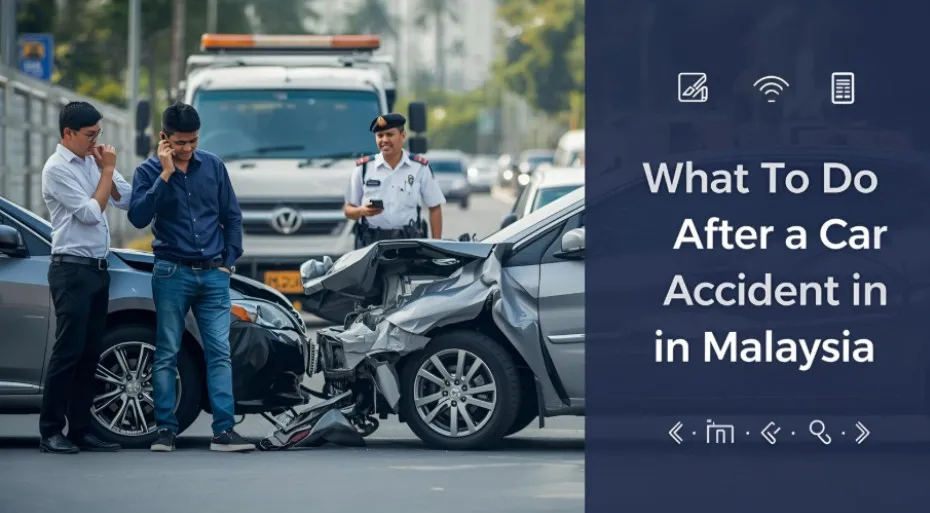
Car accidents are stressful, even when the damage looks minor. In those first few minutes, it’s easy to panic, forget what to do, or say the wrong thing at the scene. But your actions right after the crash can strongly affect:
- your safety,
- whether your insurance claim goes smoothly, and
- if your No Claim Discount (NCD) can be protected.
This guide walks you through exactly what to do after a car accident in Malaysia, step by step — from the roadside to the workshop.
If you’d like a deeper dive into the full claim journey, you can also read our overview on how car accident insurance claims work in Malaysia and our guide to the best way to file a car insurance claim in Malaysia.
Stay Calm and Check for Injuries
The first priority is people, not the car.
1. Stop your vehicle safely
- Switch on your hazard lights.
- If possible, move the car to the road shoulder or a safe area to avoid further collisions.
2. Check for injuries
- Check yourself, your passengers, and people in the other vehicle.
- If anyone is seriously hurt, call 999 for an ambulance and police.
- Do not move injured persons unless there is immediate danger (e.g. fire risk).
3. Avoid conflict
- Stay calm and polite, even if the other driver is angry.
- Don’t get into a physical argument—it can create legal trouble on top of the accident.
For more detailed guidance on what happens next, you can also refer to our article on car insurance claims after an accident in Malaysia.
Don’t Admit Fault at the Scene
One common mistake is to apologise or admit “It’s my fault” at the scene.
- You may feel responsible, but actual liability should be decided using evidence, the police report, and sometimes legal interpretation.
- An emotional apology may later be treated as an admission of fault.
Keep your conversations simple and factual:
- Exchange details,
- Take photos and video,
- Save your full explanation for your police report and your insurer.
If the accident clearly wasn’t your fault, our guide on car insurance when it’s not your fault in Malaysia explains your options in more detail.
Collect Evidence at the Scene
Good documentation helps protect you and makes it easier to handle your claim later.
Take clear photos of:
- Positions of all vehicles involved
- Close-ups of damage on each car
- Number plates
- Road markings, traffic lights, junctions, and signboards
- Skid marks or debris on the road
- Weather and lighting conditions
If you have a dashcam, make sure the footage is saved and backed up.
Also collect:
- Full name and phone number of the other driver
- NRIC (if they are willing to share)
- Vehicle make, model, and registration number
- Name of their insurance company (if available)
If there are witnesses, ask politely for their contact details.
Call Your Insurer’s Emergency or Roadside Assistance Line
Most comprehensive motor policies in Malaysia come with 24-hour roadside assistance or towing.
From the scene (or as soon as it’s safe), call:
- The emergency hotline on your windscreen insurance sticker, or
- Your agent, who can help coordinate next steps.
This helps you:
- Avoid non-panel tow trucks that may overcharge
- Get your car to a panel workshop recognised by your insurer
- Receive immediate guidance on what to do next
To understand how all these steps fit into the bigger picture, you can refer to our breakdown of the car insurance claim process in Malaysia.
Lodge a Police Report Quickly
In Malaysia, you’re generally required to make a police report as soon as reasonably possible after an accident (often within 24 hours). Failing to do so can:
- Complicate your insurance claim,
- Lead to a fine, and
- Make it harder to prove who is at fault.
When making the report:
- Describe facts, not emotions.
- Example: “My vehicle was travelling straight in the left lane when Vehicle B changed lane from the right without signal and hit the left side of my car.”
- Example: “My vehicle was travelling straight in the left lane when Vehicle B changed lane from the right without signal and hit the left side of my car.”
- Mention if you have photos or dashcam footage.
- Check the report carefully before signing.
The police report is a key document used to determine whether your case is a:
- Third-party property damage (TPPD) claim,
- Own Damage (OD) claim, or
- No-fault Own Damage / OD-KFK situation if you’re not at fault.
Know Your Claim Options
Before you send your car for repairs, it helps to understand the three main claim paths. For a fuller explanation of each, see our article on how car accident claims work in Malaysia.
a) Third-Party Property Damage (TPPD) Claim
You claim directly against the other driver’s insurer when they’re clearly at fault.
Pros:
- Your NCD is preserved, as you’re not claiming under your own policy.
Cons:
- Often slower and more tedious, since you’re dealing with another insurer.
- There may be more disputes over liability and repair cost.
b) Own Damage (OD) Claim
You claim from your own comprehensive policy when:
- You are at fault, or
- Liability is unclear or shared.
Pros:
- Often faster and simpler, especially through panel workshops.
Cons:
- Your NCD is usually affected, which may raise your next premium.
In severe accidents where your car is uneconomical to repair, you may face a total loss situation. Read more in our guide on total loss insurance claims in Malaysia.
c) No-Fault Own Damage / OD-KFK
No-fault Own Damage (often called OD-KFK) applies when:
- You claim from your own insurer,
- The other driver is at fault, and
- Certain conditions are met (e.g. both cars are private vehicles insured in Malaysia, no bodily injury claim).
Pros:
- You deal with your own insurer, so repairs can move faster.
- If accepted as OD-KFK, your NCD is preserved even though your insurer pays for your repairs.
Cons:
- Only available in specific scenarios and policy types.
- The insurer decides based on the police report and evidence.
Send Your Car to a Panel Workshop
Your insurer will usually send or recommend your car to a panel workshop.
At the workshop:
- The car is inspected and a repair estimate is prepared.
- An adjuster may be appointed to verify the damage and cost.
- The workshop helps prepare and submit documents to your insurer, such as photos, the police report, and estimate.
Ask the workshop:
- The expected timeline for repairs
- Whether you have to pay any excess or betterment
- If your policy offers a courtesy car or replacement vehicle
If you feel lost at any stage, you can always reach out via our Car Insurance Help Centre for guidance.
Prepare the Documents Your Insurer Needs
To keep things smooth, prepare and organise:
- Completed claim form from your insurer
- Your police report
- Third-party police report (if available)
- Police sketch plan / investigation result, once issued
- Copies of your NRIC and driving licence
- Copy of your Vehicle Registration Card / VOC
- Photos of the accident and damage
- Repair estimate from the workshop
- Any towing or related receipts (if you’re claiming reimbursement)
Keep everything in a dedicated folder or digital file so it’s easy to reference.
Follow Up on Claim Approval and Repairs
Once your insurer has all documents, they will:
- Confirm the type of claim (TPPD, OD, or OD-KFK),
- Approve or adjust the repair cost, and
- Authorise the workshop to start repairs.
You should:
- Request a claim number for tracking,
- Check in periodically on the status of repairs, and
- Ask about any excess or additional charges you don’t understand.
Before you collect your car:
- Inspect the repaired areas (paint, panel alignment, lights, sensors).
- Make sure there are no warning lights on the dashboard.
- Test basic functions: brakes, steering, indicators, wipers, etc.
Our detailed guide on the car insurance claim process in Malaysia can help you understand what to expect at each stage.
Common Mistakes That Can Hurt Your Claim
To avoid trouble, try not to:
- Leave the scene without exchanging details.
- Accept “cash settlement” on the spot without proper documentation.
- Admit fault verbally or in writing before speaking to your insurer.
- Delay your police report or claim notification.
- Use non-panel workshops or random tow trucks without checking with your insurer.
- Sign documents you don’t understand — always ask for clarification.
For peace of mind, you can also explore our services to see how we can support you throughout your claim.
When Should You Get Legal Advice?
Most minor accidents can be settled via normal insurance channels. However, consider speaking to a lawyer if:
- There are serious injuries or fatalities,
- Liability is strongly disputed,
- The other party threatens legal action, or
- Your claim is rejected and you believe the decision is unfair.
Legal professionals experienced in motor accident cases can help you understand your options, timelines, and risks.
Final Checklist: What To Do After a Car Accident
Here’s a quick summary you can bookmark:
- Ensure safety first – hazard lights, safe position, check for injuries.
- Stay calm and don’t admit fault.
- Document everything – photos, videos, witness contacts, third-party details.
- Call your insurer’s hotline or agent for towing and guidance.
- Lodge a police report promptly.
- Send your car to a panel workshop.
- Prepare and submit all documents needed for the claim.
- Clarify your claim type – third-party, OD, or OD-KFK if not at fault.
- Follow up on repair progress and inspect the car before collection.
- Seek professional or legal help if the case is serious or disputed.
If you’re feeling overwhelmed, our Car Insurance Help Centre is a good place to start for step-by-step support and resources.
Need Help With Your Car Insurance Claim?
We’re here to guide you on:
✅ Claim advice
✅ NCD retention
✅ Best-value insurance plans